

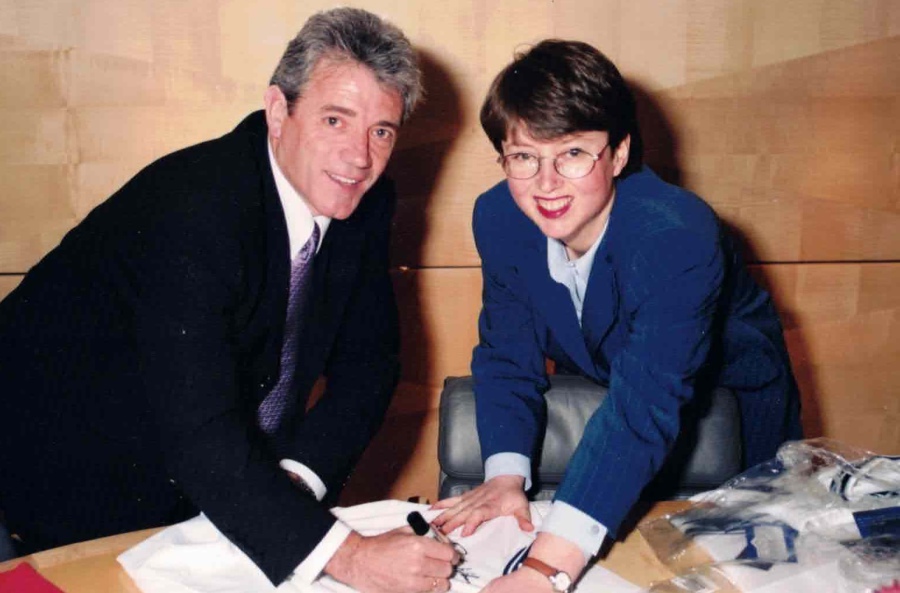
 Kevin Keegan with CASC's Wendy Perfect before a dinner at The Valley in 1999
Keegan and the Addicks - a tale of the very unexpected
by Rick Everitt
Considering that Kevin Keegan never played for or managed Charlton, and only appeared once at The Valley on an opposing side, he exerted an outsize influence on the club’s fortunes in the 1980s and 1990s.
The former England skipper and manager, who has died of cancer at the age of 75, had loomed large in the national imagination from the early 1970s onwards, throughout his successful years at Liverpool and Hamburg.
Keegan was a Football League, UEFA Cup and European Cup winner at Anfield and named European Footballer of Year in 1978 and 1979 while playing for the German club.
When England returned to the World Cup finals in 1982 after a 12-year absence, the fact that he was confined by a back injury to a 26-minute substitute appearance in a goalless group game against Spain that eliminated both countries was a personal as well as national disaster.
It also proved to be his final appearance in an England shirt after winning 63 caps. This was not his choice, but new manager Bobby Robson, who had succeeded Ron Greenwood, would not select him for his first squad or again.
Nonetheless, Keegan remained a football icon, and in 1982 was a dominant character whose profile took in appearances on BBC TV’s Superstars programme, a Top 40 hit record and a television advert for Brut aftershave alongside Henry Cooper.
That was the context of chairman Mark Hulyer’s ill-fated and extraordinary bid to intercept the 31-year-old as he completed a move from Southampton’s Dell to Second Division Newcastle United’s St James’s Park late that summer.
Fooball in England was then and is now is a small world. But Keegan existed on another continent to 1980s Charlton, if not a different planet entirely.
Given his family roots in the North East, including his father’s support for the Magpies, the attempt to sign him was always going to be a forlorn one. To many people it looked like nothing more than a publicity stunt. Within weeks, however, Charlton had signed Keegan’s predecessor as European Footballer of the Year, Allan Simonsen, from Barcelona, demonstrating that their ambition was real, albeit their targets singularly ill-judged.
How far the widespread scepticism over his pursuit of Keegan drove Hulyer on to secure his even more unlikely recruit is a matter of speculation. Simonsen’s arrival was equally astonishing. But the parochial nature of English football in the early 1980s meant it was never going to electrify the Charlton support in the way that Keegan might have done.
Still, the opportunity to see the two go head to head fuelled much anticipation as the sides prepared to meet at The Valley that December and boosted the crowd to five figures, as well as attracting ITV’s Big Match cameras. The match was also reportedly watched by 60 per cent of the Danish population.
In the event, Keegan was a no-show, Simonsen curled in the second goal in a 2-0 win and Newcastle manager Arthur Cox left behind the distinct odour of sour grapes after making dismissive comments about the Dane’s contribution to the game. It was Charlton’s second match - and first win - under caretaker manager Lennie Lawrence.
Keegan did exact a measure of revenge, however, when he scored both second-half goals against the Addicks at St James’s Park ten months later, cancelling out Paul Curtis’s first-half opener. By then, however, Simonsen was long gone.
The Newcastle striker had announced that he would retire at the end of the season by the time the return fixture came around in April 1984. Charlton were under new ownership and successfully promoted the game as Keegan’s final appearance in London, although it was also his first at The Valley. Heavily swollen by Geordies, the 15,298 crowd was the Addicks highest in the league for four years.
New chairman John Fryer presented Keegan with a crystal punch bowl before kick-off, although the visitors no doubt took more pleasure in the fact that also left with all three points, eventually securing promotion in a comfortable third place. The play-offs would not be introduced until four years later.
Charlton also returned to the top flight in 1986, but by the time they encountered Keegan again both clubs were back in the second tier. And the Addicks had also had a part in his return to Tyneside as manager.
Newcastle were struggling in 23rd place under Ossie Ardiles in January 1992 when they took a 3-0 first-half lead over Steve Gritt and Alan Curbishley’s side. Anthony Barness reduced the arrears before the interval, but an extraordinary second half produced two goals from Colin Walsh and a deflected 89th-minute winner from Alan Pardew.
Sitting in the St James’s Park press box in place of the absent Kevin Nolan, I was surrounded by the clatter of emptying seats and dropping jaws, many home fans too bewildered even to articulate their dismay. A fortnight later, Keegan was appointed Newcastle manager.
What he did next was hardly a show of appreciation. With Charlton desperate for cash to stay afloat in continuing exile at Upton Park the following season, Keegan swooped in to steal midfield star Robert Lee for a meagre £700,000 after just eight games.
In truth, Lee was going anyway. The real loser from Keegan’s intervention was Lennie Lawrence, who had moved to Middlesbrough a year earlier. Lee had been set to move to Teesside anyway. But it was especially painful because Charlton sat second in the table to Newcastle at the time of the sale, just one point adrift.
After the teams met in East London on November 14th, with Newcastle winning 3-1, that gap was 14 points. Lee played but did not score. Instead, it was Gavin Peacock, son of reserve coach and Valley legend Keith, who struck twice to set them on the way to victory.
It then took Lee just 48 seconds to score in the return fixture at St James’ Park, though Charlton fought back to earn a 2-2 draw through goals from Garry Nelson and Carl Leaburn.
Ultimately, Keegan’s side won the title, with Charlton firmly lodged in mid-table. But by then the Addicks were back at The Valley and that was all that mattered.
Then five years after Charlton had ushered Keegan into the Newcastle hotseat they also played a part in triggering his departure. Mark Kinsella’s memorable goal had just earned the still second-tier Addicks an FA Cup third round replay against the Geordies, when Keegan stormed into and out of the Portakabin which functioned as the Valley press room, startling those of us who had assembled to hear his pearls of wisdom.
It wasn't quite his famous televised meltdown about Alex Ferguson but it was another emotional moment from a man whose passion was never far from the surface.
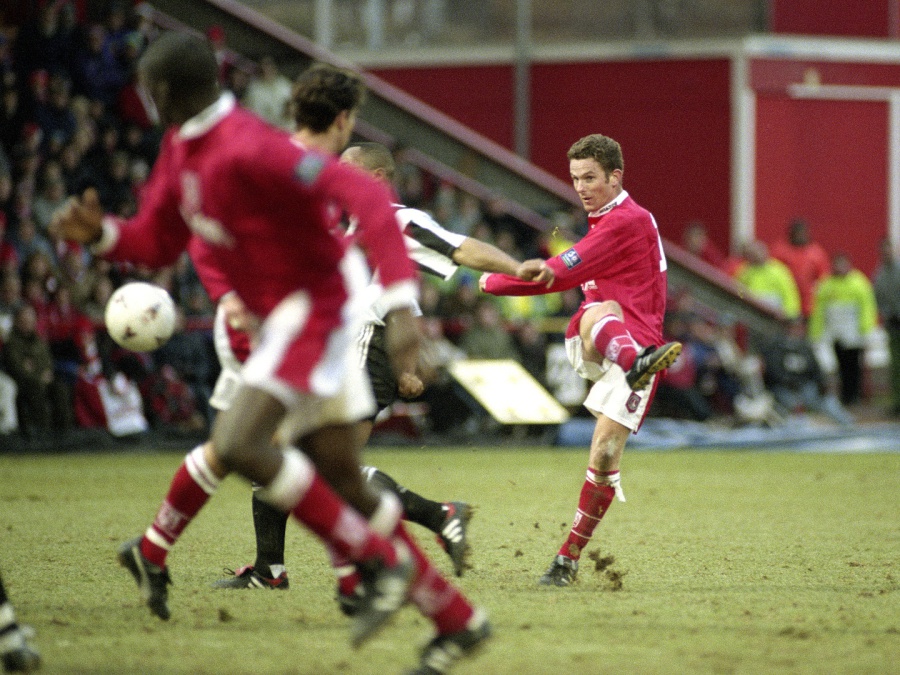 Mark Kinsella fires home Charlton's equaliser against Keegan's Newcastle at The Valley in 1997
Three days later he had resigned and the foggy replay, which Newcastle won in extra-time with a goal by Alan Shearer, was their first game under new boss Kenny Dalglish. Keegan eventually reappeared in charge of third tier Fulham and then replaced Glenn Hoddle as England manager in February 1999.
He created a much better impression when he appeared that year as guest speaker at the annual Back to The Valley dinner, which was co-ordinated on behalf of the official supporters’ club by its part-time organiser, Wendy Perfect.
“Kevin Keegan was lovely,” she remembered. “He was England manager at the time and we had arranged for him to attend through Les Reed, who had rejoined the FA from Charlton.
“Unfortunately, there was a problem over the original date, but Keegan dealt with this by calling me personally at home. My daughter Emily, who was 11, found herself answering the phone to the England manager and my kids have never forgotten that.
“Then, on the night, he couldn’t have been more co-operative. I started explaining what we had planned and he just stopped me and said that he would do whatever we wanted over the next few hours. He had no airs and graces, and couldn’t have been nicer. I’m pretty sure that he didn’t take a fee, either.”
Having quit the England job abruptly after losing the last game at the old Wembley to Germany, Keegan resumed his domestic managerial career at Manchester City, steering them back to the top flight in 2002.
He would take charge of five more games against the Addicks, losing out to a Sean Bartlett winner on Charlton’s final visit to Maine Road, before a 2-2 draw at The Valley a month later. Both goals in that game were scored by Marc Vivien Foe, but tragically when the teams met again in the opening fixture of the following season they needed to observe a minute’s silence for the striker who had died while playing for Cameroon that June. The tragic tribute was shared with Jane Murray, recently deceased wife of Charlton’s plc chairman Richard.
It was also Alan Curbishley’s 600th match in charge but the mood was not lifted by a 3-0 home defeat. The return fixture at the City of Manchester Stadium in January ended in a 1-1 draw, with Paolo di Canio’s only league goal for Charlton in open play securing the point.
There was another heavy defeat in Manchester the following August, with City running out comfortable 4-0 winners, but before the teams met again in April Keegan had quit.
He would not come face to face with the Addicks again. There is, however, one entertaining footnote, contained in his autobiography, published in 2018, in which he demolishes Tony Jimenez, who he had encountered on a brief return to Newcastle in 2008.
The man who would go on, apparently, to own Charlton from 2011-2014, was in charge of Newcastle’s recruitment but seemingly had no understanding of the need for overseas players to obtain work permits, told Luka Modric’s agent that his player wasn’t good enough for the Premier League and had never heard of German international Per Mertesacker. Keegan described the former Chelsea matchday steward as “bewildering”.
Jimenez was a big man only in the literal sense. Keegan, at five-foot-eight, was a giant. Charlton were mere extras in one of English football’s greatest stories, but that the club should have played any part at all would have seemed incredible when Hulyer set out to sign him in 1982.
BACK NUMBERS
To order issues published between April 2013 and April 2022, please see the back issues pages. VOTV124, VOTV127 and 176 are sold out.
 Share
Share Print
Print 